

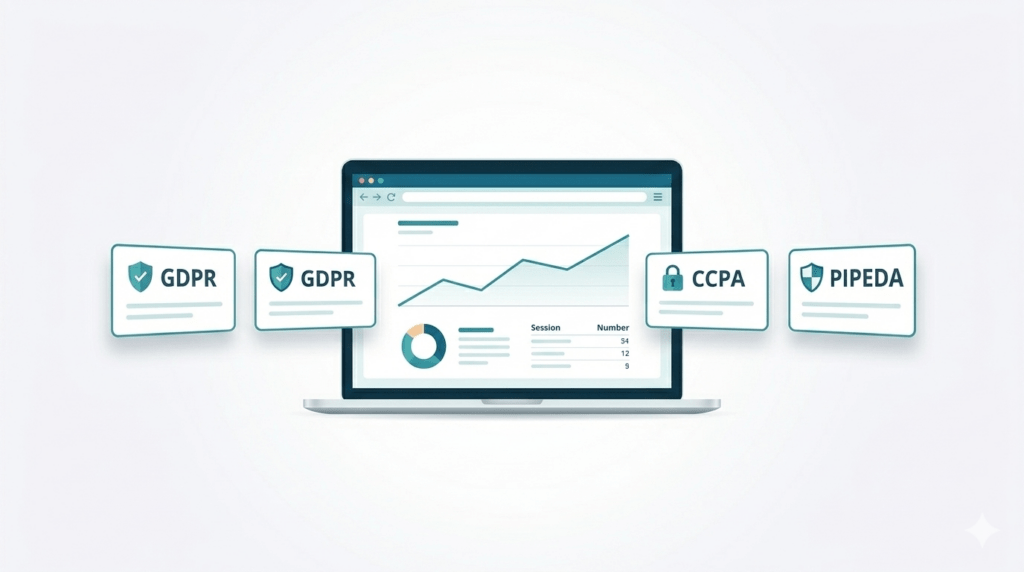
By Harish Gautam · March 2025 · Digital Marketing & Privacy Law
Understanding privacy compliance and website analytics has become one of the most critical skills in digital marketing — and one of the most legally consequential.
Every time you open a website, dozens of invisible processes begin. Scripts fire. Cookies drop. Your IP address, device type, location, and behaviour are logged within milliseconds — usually before you have clicked anything at all. For digital marketers, this data is the lifeblood of modern campaigns. For consumers, it raises serious questions about consent, transparency, and control.
This guide is written for digital marketing students, practitioners, small business owners, and anyone building a career in the data-driven marketing ecosystem. We cover the technical mechanics of tracking, the tools that power it, the laws that govern it, and the practical steps every marketer should take right now.
Why Data Matters in Digital Marketing
Digital marketing without data is guesswork with a budget. The ability to measure, understand, and act on user behaviour is what separates modern marketing from broadcast-era advertising. When a brand can see which channels drive conversions, which pages cause users to leave, and which creatives generate the highest ROI, it can allocate budget with a precision that was simply impossible before the internet.
Marketers who use data-driven strategies generate three times the ROI compared to those who do not. Eighty percent of consumers now expect personalised experiences — and brands that fail to deliver them risk losing customers to competitors who can. Global digital advertising spend has surpassed $500 billion annually, and every dollar of that spend depends on data to prove its effectiveness.
But here is the tension that defines the modern marketing profession: the same data that makes campaigns more effective also creates profound privacy risks. Understanding that tension — and navigating it legally, ethically, and intelligently — is one of the most important skills a digital marketer can develop.
Privacy compliance is no longer a legal department problem. It lives in the marketing team's tools and day-to-day decisions. A marketer who installs Google Analytics without a proper consent setup, or adds a Meta Pixel without disclosing it in a privacy policy, is exposing their employer to regulatory risk — regardless of intent. Ignorance is not a legal defence under GDPR.
How Website Tracking Actually Works
When a user navigates to a website, their browser makes an HTTP request to a web server. The server responds with HTML, CSS, and JavaScript — and embedded within that JavaScript are tracking scripts. These execute automatically as the page loads. By the time the page is visible to the user, multiple forms of tracking have already occurred.
The Three Core Tracking Technologies
Browser cookies are the most widely known mechanism. A cookie is a small text file deposited in the user's browser. First-party cookies are set by the website itself — keeping you logged in, remembering your shopping cart. Third-party cookies are set by external domains (ad networks, analytics platforms) and track users across multiple websites, building detailed behavioural profiles.
Tracking pixels — sometimes called web beacons — are tiny 1×1 pixel images embedded in web pages or emails. When the browser fetches the image, it sends a request to the tracking server including the user's IP address, browser type, screen resolution, and page URL. The Meta Pixel and Google's conversion tracking both rely on this mechanism.
JavaScript tags are the most sophisticated and prevalent form of tracking today. Tools like Google Analytics 4, Hotjar, and LinkedIn Insight Tag operate through JavaScript loaded directly or via a tag manager like Google Tag Manager. These scripts capture clicks, scroll depth, form submissions, video views — and transmit them to analytics servers in real time.
Many websites fire tracking scripts before the user has interacted with a cookie consent banner. This is not a minor technicality — it is a direct violation of GDPR. In 2022, French regulators fined Google €150 million and Facebook €60 million specifically because their consent rejection mechanisms were more complicated than acceptance. The tracking was already happening before users had the chance to say no.
Common Analytics Tools Marketers Use
Each tool collects data differently, transmits it to different servers, and carries different compliance obligations. Disclosing these tools in your privacy policy is a legal requirement — not optional.
Google Analytics 4 (GA4)
GA4 is the dominant web analytics platform, used by approximately 53% of all websites. It replaced Universal Analytics in 2023 and introduced an event-based data model, tracking page views, sessions, conversions, audience demographics, and traffic sources. In 2024, Google introduced Consent Mode v2, which uses machine learning to model traffic from users who decline consent. GA4 sets first-party cookies (_ga, _gid) found on approximately 46% and 18% of all websites respectively.
Meta Pixel
The Meta Pixel (formerly Facebook Pixel) tracks visitor actions after exposure to Facebook or Instagram ads, enabling retargeting and lookalike audience creation. Found on approximately 15% of all websites. In August 2025, Swedish regulators fined pharmacy chains €15 million for deploying the Meta Pixel and transmitting health-related browsing data to Meta without valid consent — establishing clearly that website owners, not Meta, bear the compliance responsibility.
Hotjar
Hotjar records actual user sessions — mouse movements, clicks, scroll depth, screen recordings — and generates heatmaps. Because it records real user interactions, it carries significant privacy obligations including masking any personal data that may appear on screen during a recording.
Other Tools to Disclose
LinkedIn Insight Tag, TikTok Pixel, Microsoft Clarity, Segment, and email marketing pixels embedded in newsletters all represent data processors that must be named in your privacy policy and governed by appropriate data processing agreements.
What Data is Actually Collected
The scope of data collected by a typical modern website would surprise most users. These categories directly determine the scope of your privacy obligations:
- Behavioural data: pages visited in sequence, time per page, click paths, exit points, on-site search queries, scroll depth, and form interactions — including what was typed before a form was abandoned.
- Technical data: browser type and version, operating system, screen resolution, device type, and network connection speed.
- Location data: IP address, resolving to approximate geographic location. Under GDPR, IP addresses are classified as personal data because they can — in combination with other information — identify an individual.
- Session identifiers: cookie IDs that stitch a user's visits together across multiple sessions, sometimes across weeks or months.
- Referral data: the URL a user came from, including search queries that brought them to the site.
- Conversion data: purchases, form submissions, phone call initiations, account creations — attributed to specific marketing channels.
Users often dramatically underestimate how much data is collected during a single website visit. What feels like a browse is, from a data perspective, a structured transaction with dozens of third-party servers.
— Web Almanac 2025, HTTP ArchiveWhy Privacy Laws Exist
Privacy laws did not emerge from abstract philosophical concern. They emerged from documented abuses — data sold without disclosure, profiles used to manipulate elections, medical information shared with employers, security breaches that exposed millions to identity theft. The regulatory framework governing digital marketing is a direct response to an industry that prioritised data collection over human dignity.
The concerns that drove legislators to act include: users not knowing they were being tracked; data sold to third parties without notice or consent; behavioural profiles used to manipulate purchasing decisions; technical complexity making it virtually impossible for ordinary users to understand what was happening to their data; and breaches exposing sensitive information to criminals and hostile actors.
In practical terms, privacy laws impose obligations in three areas:
- Disclosure — telling users what you collect and why.
- Consent — obtaining permission before processing personal data for non-essential purposes.
- Rights — allowing users to access, correct, or delete their data on request.
GDPR, CCPA, and Global Regulations Explained
| Law | Jurisdiction | Applies To | Max Penalty | Key Requirement |
|---|---|---|---|---|
| GDPR | European Union | Any org. processing EU resident data | €20M or 4% of global revenue | Explicit consent before tracking; data subject rights |
| CCPA / CPRA | California, USA | Businesses with CA resident data | $7,988 per intentional violation | Right to opt out of data sale; disclosure required |
| PIPEDA | Canada (Federal) | Private-sector organisations | C$100,000 | Meaningful consent; data minimisation |
| CPPA / Bill C-27 | Canada (Proposed) | Private-sector organisations | 5% global revenue or C$25M | Stronger rights; AI transparency; higher fines |
GDPR: The Global Standard-Setter
The General Data Protection Regulation came into force in May 2018 and remains the most comprehensive and globally influential privacy law ever enacted. Its reach extends beyond Europe — any organisation anywhere in the world that processes personal data about EU residents must comply. GDPR requires a valid legal basis for every instance of personal data processing. For marketing tracking, that legal basis is almost always explicit, freely given, informed, and unambiguous consent — it cannot be hidden in terms and conditions, pre-ticked, or obtained through dark patterns.
GDPR grants individuals: the right to access their data, the right to rectification, the right to erasure ("right to be forgotten"), the right to data portability, and the right to object to processing. Organisations must respond to requests within 30 days.
CCPA and CPRA: California Leads the US
The California Consumer Privacy Act (2020) and its successor CPRA give California residents the right to know what data is collected, the right to opt out of data sales, the right to deletion, and the right to non-discrimination for exercising privacy rights. While the US lacks a federal privacy law, 2025 saw Delaware, Iowa, Nebraska, New Hampshire, and several other states enact their own legislation — creating a compliance patchwork for businesses operating nationally.
Canadian Privacy Law: From PIPEDA to CPPA & Bill C-27
Canada's approach to digital privacy is undergoing its most significant transformation in history. Digital marketers serving Canadian markets need to understand both the current law and where it is heading.
PIPEDA: Canada's Original Framework
The Personal Information Protection and Electronic Documents Act became law in 2000 — before the smartphone, before social media, and long before the algorithmic data economy that defines digital marketing today. PIPEDA established 10 Fair Information Principles governing how private-sector organisations collect, use, and disclose personal information commercially. It was phased in gradually, applying first to federally regulated industries before extending to all private-sector commercial activity by 2004.
PIPEDA aged poorly. Its enforcement mechanism was widely criticised as toothless — The Office of the Privacy Commissioner of Canada could investigate and make recommendations but could not directly impose fines. Mandatory data breach reporting was added only in 2018, nearly two decades after the Act passed. And PIPEDA said nothing about algorithmic decision-making, AI profiling, or the data practices of platform businesses that did not exist when it was written.
Canadian Privacy Law Timeline
Bill C-27 and the Consumer Privacy Protection Act
Introduced in June 2022 and still progressing through Parliament as of 2025, Bill C-27 is a three-part legislative package. The first part — the Consumer Privacy Protection Act (CPPA) — would replace PIPEDA and introduce GDPR-style fines of up to 5% of global revenue or C$25 million, whichever is greater. That is a dramatic escalation from PIPEDA's C$100,000 maximum.
The second part establishes a Personal Information and Data Protection Tribunal — an independent body that can adjudicate complaints and impose fines directly, replacing the recommendation-only model of the current Privacy Commissioner regime. The third part — the Artificial Intelligence and Data Act (AIDA) — proposes Canada's first regulatory framework governing high-impact AI systems, including algorithmic decision-making and automated profiling. This directly affects digital marketers using AI-powered personalisation, recommendation engines, and programmatic ad-targeting.
The CPPA also introduces new consumer rights: data portability, the right to disposal of personal information, and the right to an explanation when an algorithm makes a consequential decision about you.
If Bill C-27 passes in its current form, Canadian businesses using analytics platforms, ad pixels, and AI-powered personalisation tools will face compliance obligations very similar to GDPR. Building GDPR-grade compliance infrastructure today means being ready when CPPA becomes law — rather than scrambling to retrofit systems under deadline.
Real Fines, Real Consequences
By January 2025, cumulative GDPR fines had reached approximately €5.88 billion — and the pace of enforcement is accelerating. These are not all big-tech penalties. Regulators have expanded scrutiny to financial services, healthcare, energy providers, and mid-size businesses.
The Swedish pharmacy case is particularly instructive. It established unambiguously that when a business installs a third-party tracking pixel, that business is responsible for the resulting data collection — even when the pixel is provided by a platform like Meta. You cannot outsource compliance responsibility to your tools.
Cookie Consent Banners Done Right
Cookie consent banners are widely misunderstood. Many businesses treat them as a legal formality to check off. Regulators have become expert at spotting the difference.
What a Compliant Banner Must Do
- Appear before any non-essential cookies fire. Tracking scripts must be blocked until the user chooses. If GA4 or Meta Pixel runs on page load before the banner is interacted with, you are already in violation.
- Offer equally prominent Accept and Reject options. A large "Accept All" button alongside a tiny "Manage Preferences" link is a dark pattern. Regulators have fined organisations specifically for this asymmetry.
- Explain what each cookie category does in plain, non-technical language — not just "functional targeting optimisation."
- Remember the user's choice across visits and not re-prompt unnecessarily.
- Allow users to change their preference at any time via a persistent link — typically in the footer.
- Not use pre-ticked boxes — GDPR requires an active, affirmative action for consent.
1. Tracking scripts firing before consent is obtained. 2. No genuine "Reject" option — only "Accept All" and a buried preferences page. 3. Privacy policies that don't name the specific third-party tools used. 4. Banners that don't honour the user's choice on subsequent visits.
What Goes in a Privacy Policy
Every website that collects personal data must have a privacy policy that is publicly accessible, written in plain language, and genuinely informative. Under GDPR it must be "concise, transparent, intelligible, and easily accessible." Under CCPA it must appear in a "conspicuous" location.
A legally adequate privacy policy must cover:
- Identity of the data controller — who is responsible for the data, including contact details and a Data Protection Officer where GDPR requires one.
- What data is collected — names, email addresses, IP addresses, cookie identifiers, behavioural data, purchase history — specific categories, not vague descriptions.
- Why it is collected — the specific purpose for each category. "To improve your experience" is insufficient under GDPR.
- Legal basis for processing — consent, legitimate interest, contract, legal obligation, vital interest, or public task. Each processing activity needs its own stated basis.
- Who receives the data — every third-party tool named specifically. GA4, Meta Pixel, Hotjar, Mailchimp, HubSpot — all five must be listed.
- Data retention periods — how long each category is kept, and why.
- User rights and how to exercise them — with a response timeline commitment (30 days under GDPR).
- How to complain — contact details for the relevant supervisory authority in your jurisdiction.
Compliance Tools: Small Business to Enterprise
For Small Businesses and WordPress Sites
WordPress powers approximately 43% of all websites, making WordPress compliance plugins critically important. Two tools stand out:
Complianz — a wizard-driven plugin that guides website owners through setup, automatically scans for cookies, categorises them, blocks non-essential scripts until consent is given, and generates customised privacy policy content. Used by more than 800,000 WordPress sites.
CookieYes — automatically detects and categorises cookies, generates customisable banners, stores consent logs for audit purposes, and integrates with Google Consent Mode v2. A free tier covers smaller sites.
Neither tool is "install and forget." When new tracking scripts are added, the cookie inventory must be updated, the privacy policy reviewed, and the banner retested.
For Enterprise Organisations
OneTrust is the market leader — used by approximately 75% of Fortune 500 companies. It provides automated cookie scanning, multi-jurisdiction consent configuration, data subject request (DSR) workflows, privacy impact assessments, and integration with more than 200 technology platforms.
Cookiebot (now part of Usercentrics) is a Google-certified Consent Management Platform (CMP) trusted by over 4 million websites. It provides real-time consent synchronisation, a consent log for legal audit trail, and support for the IAB Transparency and Consent Framework (TCF) used across the programmatic advertising ecosystem.
The Future: First-Party Data & Cookieless Tracking
The third-party cookie — once the backbone of digital advertising — is in structural decline. Safari and Firefox have blocked third-party cookies for years. While Google reversed its Chrome deprecation plan in 2024, the trajectory is clear: marketers must build on first-party data, or face increasingly degraded signal quality.
First-party data — purchase history, email sign-ups, loyalty programme participation, on-site search queries, account preferences — is collected directly from users with explicit awareness. Companies with strong first-party data programmes report 2.9× better customer retention and 1.5× higher marketing ROI compared to those reliant on third-party cookies.
Technical Alternatives to Cookie-Based Tracking
- Server-side tagging — moves tracking logic from the user's browser to a server you control. More resilient to browser restrictions, better page performance, and tighter control over what data reaches third parties.
- Privacy-preserving analytics — platforms like Matomo (self-hosted with IP anonymisation) and Plausible provide website insights without cookies, without third-party data sharing, and without triggering consent requirements in many jurisdictions.
- Marketing Mix Modelling (MMM) — statistical technique using aggregated data rather than individual-level tracking to estimate channel contribution. Experiencing a renaissance as cookie-based attribution degrades.
Ethical Digital Marketing
Compliance is the floor. Ethics is the ceiling. Privacy law tells marketers what they must do; ethical practice asks what they should do — and the gap between those two is where trust is won or lost.
Only 27% of consumers trust technology providers with their personal data. Brands that treat privacy as a genuine value — not merely a legal checkbox — consistently outperform on customer lifetime value, retention, and brand preference. Apple's privacy marketing is the most high-profile example of a company turning privacy into a competitive differentiator.
Marketers who treat privacy as an obstacle will keep accumulating fines and losing consumer trust. Marketers who treat privacy as a value will build the kind of first-party relationships that no algorithm can replicate.
— Harish Gautam, harishgautam.netThree principles define ethical data practice:
- Transparency — tell users in plain language what you collect, why, and who sees it. Not in a 40-page policy designed to obscure, but in clear, accessible communication.
- Minimisation — collect only what you genuinely need for a specific stated purpose. More data means more risk, more cost, and more exposure.
- Respect — honour opt-out choices without re-prompting or finding technical workarounds to track users who declined.
Marketer's Privacy Compliance Checklist
Use this to audit your current setup — or evaluate any digital marketing property you work on:
- ✓ Cookie audit completed — every cookie and tracking pixel identified and categorised.
- ✓ Consent Management Platform (CMP) installed and configured for your target jurisdictions.
- ✓ Tracking scripts blocked until consent is obtained — verified in a clean browser.
- ✓ Cookie banner offers genuinely equal Accept and Reject options with no dark patterns.
- ✓ Privacy policy publicly accessible, names all third-party processors, and states retention periods.
- ✓ Google Consent Mode v2 implemented if using GA4 or Google Ads.
- ✓ Data Processing Agreements (DPAs) signed with all third-party vendors.
- ✓ User rights workflow in place — process to handle access, deletion, and portability requests within 30 days.
- ✓ Data breach response plan documented and staff trained on notification timelines.
- ✓ Privacy policy reviewed and updated whenever a new tool or pixel is added.
- ✓ First-party data strategy in development — email list, loyalty programme, or account-based collection.
- ✓ If operating in Canada: monitoring Bill C-27 / CPPA progress and building GDPR-grade infrastructure now.
Key Takeaways
- Every analytics tool carries disclosure obligations. GA4, Meta Pixel, and Hotjar all collect personal data. Every tool used must appear in your privacy policy and be governed by a consent architecture that gives users a genuine choice.
- Privacy laws apply regardless of company size. The Swedish pharmacy fines targeted mid-size businesses, not Big Tech. There is no size exemption.
- Consent must be freely given, specific, informed, and unambiguous. Banners that manipulate users into clicking Accept, or that fire tracking scripts before consent, are legally invalid.
- Canada is adopting GDPR-equivalent privacy law. Bill C-27 / CPPA would introduce fines of up to C$25 million and new rights around AI-driven decision-making. Build GDPR-grade infrastructure now.
- The cookie era is ending. First-party data, server-side tagging, and privacy-preserving analytics are present requirements — not future considerations.
- Privacy done well is a competitive advantage. Brands that build genuine trust through transparent data practices achieve higher lifetime value, lower churn, and stronger loyalty.
Teaching This Topic?
Get the free 17-slide classroom presentation covering analytics tools, privacy laws, GDPR, CCPA, and Canada's Bill C-27 — enter your email via the contact form and I'll send it directly.
Send Me the Free Slide Deck →This article is written for educational and informational purposes only. It does not constitute legal advice. For specific compliance questions, consult a qualified privacy law professional in your jurisdiction.