

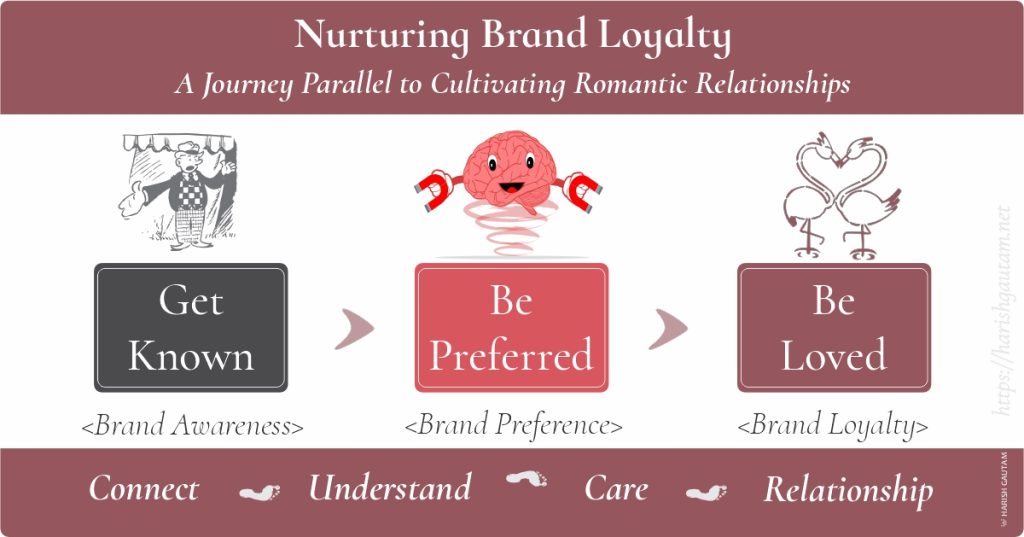
Imagine your first day at a new school. Everything is unfamiliar and unknown. Timid and curious at the same time, you step into your classroom, making your first appearance, trying to gather some awareness about your surroundings. This is the beginning of your journey, akin to a customer’s initial stage of brand awareness.

As days go by, your interactions with your peers grow, they recognize you, and you become a known face in the crowd. Just like your journey, brands make an effort to be recognized by their target customers, ensuring their services and products are top-of-mind, thereby moving to the stage of brand recognition.

During your time at school, you start engaging with like-minded individuals, understanding their likes and dislikes, their needs, and their expectations. This understanding is much like a brand’s thorough research and targeting of its customers, ensuring it meets the customer’s needs and wants.
As you start caring for others, and showing empathy and understanding, your peers start to appreciate you more. This bond of trust and emotional connection is the exact essence of relationship marketing, a strategic approach that brands take to build long-lasting relationships with their customers.

Finally, as the school year comes to an end, you might find that you have formed a strong bond with someone, a bond so strong that it surpasses all the obstacles. This special bond represents brand loyalty, where customers overlook the price and other options available in the market, choosing to stay loyal to the brand that caters to their needs and values. Just like in school, where you might fall in love with someone by spending time and understanding them, customers become loyal to a brand by understanding and connecting with the brand over time.

This journey from awareness to love is exactly how brand loyalty forms. It starts with brand awareness, grows with brand recognition, strengthens with relationship marketing, and culminates in brand loyalty, just like your journey at school.
Just like a love story, the journey towards brand loyalty commences with a chance meeting – the moment of first contact or brand awareness. This stage is akin to an introduction, where customers discover a brand for the first time. The next phase is brand preference, where the relationship deepens, and customers start favouring the brand over its competitors. Finally, the saga culminates in brand loyalty, an enduring bond where customers become steadfast advocates for the brand.
Relationship marketing is the catalyst in this love story, nurturing the bond between a brand and its customers. By prioritizing customer engagement and satisfaction, relationship marketing fosters trust and understanding, solidifying customer loyalty. It’s the careful cultivation of shared values and genuine care that transforms casual customers into loyal advocates.

A key tenet of robust brand loyalty is genuine appreciation for brand offerings, transcending the ephemeral allure of financial incentives. Customers who gravitate towards your brand solely due to discounts and promotional benefits can be likened to fair-weather friends; their loyalty is contingent on the continuation of such monetary gains. These individuals are price-sensitive and may easily be enticed by competing brands offering superior deals, thus their loyalty is fleeting and inconsistent.
The primary objective for marketers should be to cultivate relationships with customers who perceive your offerings as being uniquely congruent with their needs and desires. Such customers exhibit true brand loyalty, as they value the core offerings and ethos of your brand over any short-term financial gain offered by competitors. This form of loyalty is enduring and is not easily swayed by market fluctuations or competitive offerings. Therefore, marketers must endeavor to identify and nurture these authentic relationships, as these loyal customers form the cornerstone of sustainable, long-term success.

Building brand loyalty is a calculated process that requires deliberate strategies. These include: creating high-quality products, investing in excellent customer service, engaging customers through social media, and embracing corporate social responsibility. Brands should also leverage relationship marketing techniques such as personalization, reward programs, and exclusive deals for loyal customers.

In conclusion, brand loyalty is not an overnight phenomenon. It’s an enduring love story that unfolds through stages, nurtured by relationship marketing, and transcending the constraints of price. It’s a testament to the power of a brand that genuinely cares for its customers, and businesses must invest in cultivating these relationships for lasting success.
