

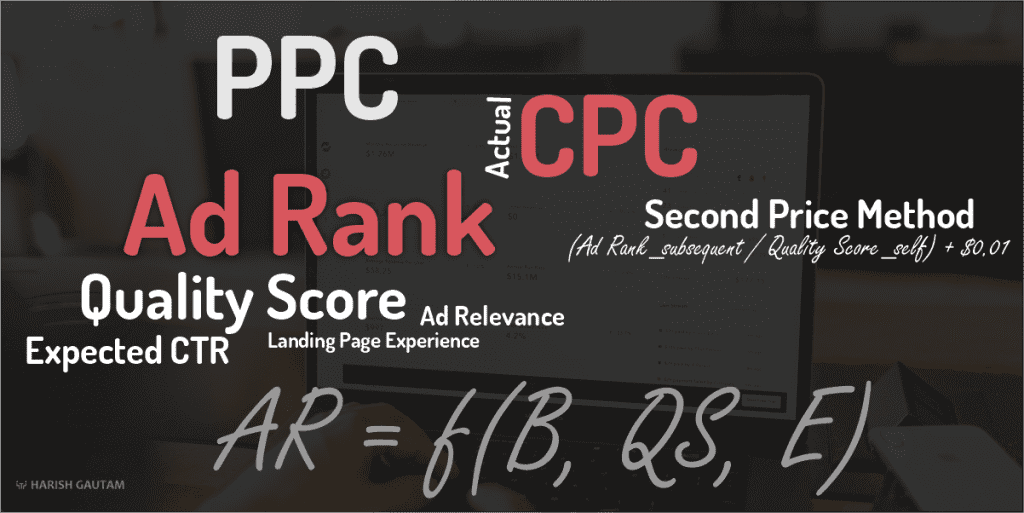
In the fascinating world of digital marketing, Google’s innovative Pay-Per-Click (PPC) algorithms have revolutionized the landscape. The cornerstone of this mechanism is the concept of Ad Rank—a unique metric that significantly impacts the Cost Per Click (CPC). The Ad Rank provides an intuitive, efficient bidding system that is primarily determined by the Second Price Method. This sophisticated yet comprehensive system ensures advertisers pay the most optimal price for their ads, thereby fostering a competitive and fair marketing environment. Understanding and strategically maneuvering these elements can lead to enhanced exposure and marketing success, a testament to the brilliance of Google’s PPC model. Understanding these concepts is crucial to executing successful paid search campaigns and getting the most out of your advertising budget. Although PPC and CPC are often used interchangeably, they are not the same. PPC is the strategy, while CPC is the metric.
Google’s PPC Algorithm: A Glimpse
Google’s Pay-Per-Click (PPC) algorithm is a complex system that determines which ads will appear in the search engine’s sponsored results and in what order. The algorithm operates based on an auction model wherein advertisers bid on keywords relevant to their target audience. However, unlike traditional auctions, the highest bid does not necessarily guarantee the top ad position. This is where the intricacies of the algorithm come into play, particularly the Second Price Method. The Second Price Method ensures that advertisers pay only slightly more than the next highest bidder, rather than their maximum bid. This method not only creates a fair bidding environment but also encourages advertisers to bid truthfully. Understanding this aspect of Google’s PPC algorithm is crucial for maximizing your ad campaigns’ effectiveness and return on investment.
Understanding the Second Price Method is the first step in deciphering Google’s PPC algorithm. However, to fully grasp how the algorithm determines which ads are displayed and in what order, we must delve into the concept of Ad Rank. Simply put, Ad Rank is a value that Google assigns to your ads. In essence, a higher Ad Rank means your ad is more likely to be displayed and in a more prominent position. But how does this relate to CPC? As we’ll see in the next section, the relationship between Ad Rank and CPC is a critical aspect of your PPC strategy.
The Role of Ad Rank
Ad Rank is a fundamental concept in Google’s PPC algorithm that determines where your ad will be positioned about others. It is a value calculated by Google based on several factors including your bid amount, the relevance and quality of your ad, expected click-through rate (CTR), and the landing page experience. In essence, it’s a reflection of the overall quality and relevance of your ad to the user’s search. Google Ads Help Center – “How Ad Rank works“
The calculation of Ad Rank isn’t just about your bid amount. There are three crucial factors that Google considers while determining Ad Rank: your bid amount, the quality of your ad, and the expected impact of ad extensions and formats.
- Bid Amount: This is the maximum amount an advertiser is willing to pay for a click. While this is a significant factor, it is not the only one. A high bid amount does not automatically guarantee a high Ad Rank.
- Quality of Your Ad: Google evaluates the quality of your ad by looking at your ad’s relevance to the user’s search query, the quality of your landing page, and your ad’s click-through rate (CTR). This factor is crucial because Google aims to provide users with the most relevant ad results to their search queries. Quality Score is an essential metric in Google’s Ad Rank calculation. It represents a rating of the overall quality and relevance of both your keywords and PPC ads. Google calculates Quality Score based on three primary factors:
- Ad Relevance: Ad relevance measures how closely your ad matches the intent behind a user’s search. For example, if a user searches for “running shoes,” and your ad is about sports equipment, Google would likely deem your ad somewhat relevant. However, if your ad is specifically about running shoes, Google may consider it highly relevant.
- Expected Click-Through Rate (CTR): This estimates how likely it is that your ad will be clicked when shown for a particular keyword. The expected CTR is based on the performance of your ad on past queries that match the keyword exactly, adjusted for factors like ad position.
- Landing Page Experience: This measures how relevant and useful your landing page is to people who click your ad. High-quality landing pages offer relevant, useful, and original content, and are easy to navigate.
- Expected Impact of Ad Extensions and Formats: Google also takes into consideration the expected impact of ad extensions and formats. Ad extensions provide additional information to make your ads more useful. For instance, adding links to specific pages on your website, business locations, or phone numbers can make your ads more engaging and useful to users. Google estimates how these extensions and formats may improve your ad’s performance.
The Formula of Google Ad Rank
Traditionally, Google’s Ad Rank has been calculated using the formula:
`Ad Rank = CPC Bid * Quality Score`
Where:
- `CPC Bid` is the maximum amount an advertiser is willing to pay for a click on their ad.
- `Quality Score` as mentioned earlier is a metric that evaluates the relevance and quality of your ad and landing page to the user’s query. This is based on factors such as past click-through rate (CTR), relevance of ad, and quality of the landing page.
However, with evolving times, Google has included more parameters in the Ad Rank calculation. These additional factors include the context of the person’s search (like the time, location, device, and other attributes), the expected impact of extensions and other ad formats and the advertiser’s Ad Rank threshold. Therefore, the revised Ad Rank formula now is:
`Ad Rank = CPC Bid * Quality Score + Contextual Signals + Expected Impact of Extensions and Ad Formats + Ad Rank Thresholds`.
- `Contextual Signals` include details about the user’s search context, such as the time, location, device, etc. For instance, an ad for a pizza restaurant might have a higher Ad Rank during lunch hours because people are more likely to be searching for food around that time.
- `Expected Impact of Extensions and Ad Formats` gauges how certain attributes of your ad, like extensions, are expected to impact your ad’s performance. If you’ve added a call extension to your ad, and Google predicts that this will significantly improve your CTR, this could positively influence your Ad Rank.
- `Ad Rank Thresholds` refer to the minimum Ad Rank required for your ad to appear in a certain position. These thresholds can vary based on factors like the search query’s commerciality. For example, Google might set a higher Ad Rank threshold for a search query like “buy running shoes” (a commercial query suggesting the user is ready to purchase) compared to “how to tie shoelaces” (an informational query with less purchasing intent).
Understanding this formula is critical. A higher Ad Rank not only improves your ad positioning but also helps in potentially lowering your Cost-Per-Click (CPC). Simply put, a higher Ad Rank gives your ad a better position and can also lead to a lower CPC. Google provides a detailed guide on how Ad Rank is calculated and its impact on your ads.
The higher your Ad Rank, the better the position your ad will achieve in the search results. But Ad Rank doesn’t only affect your ad’s positioning; it also influences your Cost-Per-Click (CPC). In the context of Google’s Second Price Method, the advertiser with the highest Ad Rank pays just enough to beat the Ad Rank of the second-highest advertiser. Therefore, a sound understanding of Ad Rank and its components is instrumental in devising effective PPC strategies.

CPC: The Cost Factor
CPC is where the rubber meets the road in PPC advertising. It’s the price you pay each time a user clicks on your ad. The final CPC is determined by the Ad Rank of the next highest ad below yours divided by your Quality Score, plus $0.01. Intriguingly, a better Ad Rank can lead to a lower CPC. For instance, if your ad has a higher quality score and is deemed highly relevant to the search query, you could end up paying less per click than a competitor with a lower quality ad, even if they have bid a higher amount.
Second Price Method – Core of Google’s PPC Model
The Second Price Method is an auction strategy where the highest bidder pays the amount bid by the second highest bidder, plus $0.01. This means you won’t necessarily pay your maximum bid, but just enough to beat the second highest bidder. If you’re the highest bidder with $5 and the second highest bidder bids $3, you’ll only pay $3.01. This system helps keep CPCs in check and promotes fair competition.
The Second Price Method is indeed the secret sauce that makes Google’s advertising platform stand out. At its core, it fosters a level playing field for advertisers, big or small, and ensures that ad spots are distributed based on a mix of relevance and competitiveness, rather than purely financial muscle. Let’s illustrate this with an example: Consider two advertisers, Advertiser A and Advertiser B. Both are vying for the same ad position. Advertiser A has a Quality Score of 6 and bids $5, while Advertiser B has a Quality Score of 3 and bids $10. Despite B’s higher bid, the Ad Rank for A (calculated as Quality Score * CPC bid = 65 = 30) is higher than B’s Ad Rank (3*10 = 30). Therefore, A wins the auction. However, thanks to the Second Price Method, A doesn’t pay its bid price of $5 per click. Instead, they pay just enough to beat B’s Ad Rank. This would be calculated as B’s Ad Rank divided by A’s Quality Score plus $0.01 (30/6 + $0.01 = $5.01). So, A would pay slightly more than $5 per click, not the full $10 that B was willing to pay. This approach not only encourages advertisers to bid their true value but also rewards those with higher Quality Scores, emphasizing the importance of relevance and quality in Google’s PPC model.
Strategies for Improving Ad Rank and Lowering CPC
Improving your Ad Rank not only gets your ad in a better position but also can help lower your CPC. Strategies for this include improving the relevance and quality of your ads and landing pages, adding negative keywords to avoid irrelevant clicks, and using ad extensions to increase your ad’s visibility. Google’s guide to improving Ad Rank offers more strategies that can be implemented.
Understanding the Link Between Improved Ad Rank and Lowered CPC
It’s crucial to understand that your position about competitors is not determined solely by your bid amount. Rather, it’s decided by your Ad Rank. This critical metric of Ad Rank combines your bid with your Quality Score, a composite rating of your ad’s relevance and quality. Thus, an advertiser could bid less than you but still outrank you if their Quality Score is significantly higher. This underscores the importance of not only strategic bidding but also creating quality, relevant ads to improve your Ad Rank. With a superior Ad Rank, you can achieve better ad positions and potentially lower your CPC, even if your competitors bid higher amounts.
An improved Ad Rank results in a lower Cost-Per-Click, and it all hinges on the way Google’s advertising auction works. Essentially, you pay just enough to beat the Ad Rank of the competitor below you. Therefore, the higher your Ad Rank, the less you’ll likely need to pay to stay ahead of the competition in the bidding process.
The formula for calculating Ad Rank in the Google Ads model is:
Ad Rank = CPC Bid * Quality Score
The formula for determining the actual cost-per-click (CPC) based on the Ad Rank of the advertiser below you and your Quality Score is:

This formula helps to ensure that you pay just enough to maintain your ad’s position.
To illustrate, let’s consider another simple example. Suppose your ad has an Ad Rank of 20 and the ad below you has an Ad Rank of 15. You’ve set your maximum CPC bid as $4. However, to beat the ad with the Ad Rank of 15, you’re only required to pay $2.51 (15 divided by your Quality Score of 6, plus $0.01).
CPC_A = (AdRank_B / QualityScore_A) + $0.01
Where:
- CPC_A is the cost-per-click for Advertiser A
- AdRank_B is the Ad Rank of Advertiser B (the next competitor)
- QualityScore_A is the Quality Score of Advertiser A
This formula ensures that Advertiser A pays just enough to surpass Advertiser B’s Ad Rank, promoting fair competition and cost-efficient PPC advertising.
Thus, by improving your Ad Rank through high-quality ads and relevant keywords, you can effectively decrease your CPC, as you’re required to pay less to outperform the competitor below you. This correlation underscores the importance of continually optimizing for a better Ad Rank to achieve cost-efficiency in your PPC campaigns.
PPC Campaign Success: Putting it All Together: Understanding the interplay of Ad Rank, CPC, and the Second Price Method is essential for running successful PPC campaigns. In conclusion, understanding Ad Rank, CPC, and the Second Price Method can give you an edge in navigating the world of PPC advertising. These concepts are not just theoretical—they have practical implications for your ad positions, the competition, and most importantly, your advertising costs.
Key Takeaways
- Understand the Basics: In the world of PPC advertising, understanding the fundamental concepts such as CPC, Ad Rank, and the Second Price Method is crucial. These concepts form the bedrock of your advertising strategy and influence your advertising costs.
- The Power of Ad Rank: Ad Rank is a vital metric that determines your ad’s position. It’s calculated as a product of your CPC Bid and Quality Score. A higher Ad Rank can position your ad more prominently, even if you don’t have the highest bid.
- Relevance and Quality Matter: Google’s PPC model rewards ads that are relevant and of high quality. Your ad’s Quality Score is a critical component of your Ad Rank. Hence, focusing on creating quality, relevant ads can improve your Ad Rank and lower your CPC.
- Optimize for Lower CPC: Your actual CPC is influenced by the Ad Rank of the advertiser below you and your Quality Score. By improving your Ad Rank, you can effectively decrease your CPC, leading to more cost-efficient PPC campaigns.
- Fair and Competitive Bidding: Google’s Second Price Method ensures fair competition among advertisers. It ensures that you pay just enough to beat the Ad Rank of the next competitor, regardless of your maximum bid.
- Continuous Optimization: In PPC advertising, continuous optimization of your ads for better Ad Rank can lead to lower costs and better ad positioning, giving you a competitive edge. The importance of these concepts is not merely theoretical but has practical implications for your ad performance and costs.
Frequently Asked Questions (FAQs)
- What is Ad Rank and how does it influence my PPC campaign?
Ad Rank is a metric used by Google to determine the position of your ad in the search results. It is a product of your Cost-Per-Click (CPC) Bid and Quality Score. A higher Ad Rank can help your ad appear more prominently in search results, potentially garnering more visibility and clicks.
- How does improving Ad Rank lower the Cost-Per-Click (CPC)?
Improving your Ad Rank can lower your CPC because Google’s advertising auction system requires you to pay just enough to beat the Ad Rank of the competitor below you. Thus, the higher your Ad Rank, the less you may need to pay to maintain your ad’s position.
- What is Quality Score and how does it affect Ad Rank and CPC?
Quality Score is a rating given by Google based on the relevance and quality of your ad. This score is a critical component of your Ad Rank. A high Quality Score combined with a competitive bid can improve your Ad Rank, leading to potentially lower CPC.
- What is the Second Price Method in Google’s PPC model?
The Second Price Method in Google’s PPC model is a bidding strategy where you pay just enough to beat the Ad Rank of the advertiser below you. This strategy promotes fair and competitive bidding, ensuring cost-efficient PPC advertising.
- How does optimizing for better Ad Rank give me a competitive edge in PPC advertising?
Optimizing for better Ad Rank can lead to more prominent ad positions and lower CPC. This combination can increase your ad’s visibility, potentially leading to more clicks and conversions while saving on advertising costs.
- What strategies can I employ to improve my Ad Rank and lower my CPC?
Improving the relevance and quality of your ads and landing pages, using ad extensions to increase visibility, and adding negative keywords to avoid irrelevant clicks are some strategies that can improve your Ad Rank and potentially lower your CPC.